百思不得姐
India Calls for Early Resolution of ‘Outstanding’ Border Issues with China_我的网站

A | Beijing and New Delhi should resolve their “outstanding” border issues along the Line of Actual Control in eastern Ladakh at an early date, India’s Foreign Minister Subrahmanyam Jaishankar said on Thursday.,The Indian minister met with his Chinese counterpart Wang Yi on the sidelines of the G20 foreign ministers’ meeting in Bali, exchanging perspectives on the international situation and its impact on the G20 deliberations.,Wang also appreciated India’s support during China’s BRICS chairmanship this year and assured Beijing's support for India’s upcoming G20 and Shanghai Cooperation Organization presidency.,“India-China relationship is best served by observing the three mutuals – mutual respect, mutual sensitivity and mutual interests,” India's top diplomat reiterated.,The two countries have not made much headway in the last few rounds of dialogue on the border stand-off, agreeing only to continue discussions at senior military commander-level meetings.,The two militaries have pulled back their troops from the north and south banks of Pangong Lake and Gogra Post, while tension remains unabated in some sections of Hot Springs and the Depsang Plains.The deadlock continues, while both sides call for a peaceful resolution of the border issue.,During Wang's New Delhi visit in March, the Indian foreign minister pushed for a speedy disengagement at all friction points to set the stage for de-escalation along the LAC and normalizing bilateral ties.,The 16th senior commander-level meeting will likely be held later this month.,Want to know more? Check out our Koo & Telegram accounts!,Koo: https://www.kooapp.com/profile/sputniknews,Sputnik India: https://t.me/sputniknewsindia。
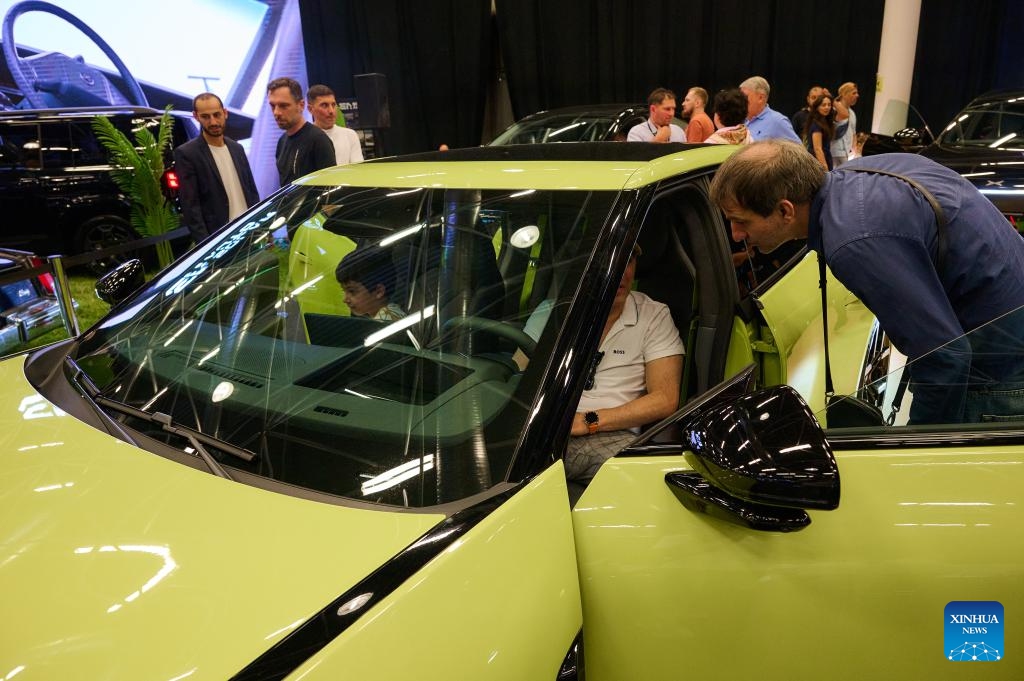
Visitors view an Xpeng electric vehicle at Expo Georgia in Tbilisi, Georgia, June 13, 2026. This year's expo was held here from Saturday to Sunday. Chinese automakers including BYD, XPeng, AVATR and JAC Motors have made appearances with their products at the expo. (Photo: Xinhua)
China-made electric vehicles (EVs) accounted for 14.2 percent of European market sales in the first five months of 2026 despite the EU's steep tariffs. The growth showed that trade‑protectionist barriers can only serve as short‑lived obstacles, as consumers' purchasing choice ultimately hinges on product competitiveness and China's EV strengths will support the automakers' long‑term growth, Chinese experts said.
The market share of electric cars sold by Chinese companies rose to 14.2 percent in European market in the first five months of this year, according to Schmidt Automotive Research. The 171,800 EVs sold there represented an increase in market share of five percentage points from one year earlier, the Guardian reported on Sunday.
The increase in European sales comes despite EU tariffs of up to 35.3 percent for EVs made by some Chinese manufacturers, on top of the standard 10-percent import duty. The UK is the largest European market for Chinese cars because London has declined to follow the EU's lead in imposing more levies. The UK accounted for a quarter of Chinese EV sales in Europe, according to the report.
Cui Dongshu, secretary-general of the China Passenger Car Association, told the Global Times on Monday that the surge showed trade protectionist policies have failed to contain Chinese automakers' overseas expansion.
Chinese EVs enjoy "a generational edge" over Europe's legacy carmakers. Their overall product strength remains the primary reason behind their popularity among European buyers, Cui said.
Meanwhile, fluctuating global oil prices have pushed up driving costs throughout Europe, fueling demand for affordable electric vehicles, a need well‑met by the affordable Chinese‑made models. Meanwhile, the gradual return of European electric‑vehicle purchase subsidies has lowered purchase barriers and lifted total EV sales, which has in turn worked to the advantage of Chinese exporters, Cui Dongshu said.
Chinese brands expanded their market share in Europe in the first half of 2026 driven by local subsidies and higher oil prices, Fitch Ratings said in a report sent to the Global Times.
The combined market share of leading Chinese brands in the EU, European Free Trade Association and UK rose to 11 percent in the first half of this year, up from 7 percent in the first half of 2025. The largest Chinese players, Geely Group (including Volvo Car) and SAIC Motor, expanded steadily despite the tariffs. The main drivers of market share gains were BYD, Chery and Leap Motor, according to Fitch Ratings.
Cui Dongshu noted that China's EV edge comes from its full‑fledged industrial ecosystem.
Officials from China's Ministry of Commerce told a press conference on July 28 that China boasts a complete, high‑efficiency EV industrial chain covering raw materials, auto parts, finished cars and production equipment, with industry clusters enabling rapid component supplies. China's huge market, the world's largest, has fueled 11 consecutive years of EV sales.
"Protectionism can only put up short‑term entry barriers. It cannot erase the solid strengths of Chinese EVs or stop Chinese brands from establishing a lasting foothold in Europe," Cui Dongshu said.
Yet, geopolitical risks remain as the EU reportedly considers expanding tariffs to restrict Chinese plug-in hybrid EVs.
German media Handelsblatt reported on June 19 that the EU is drawing up new measures to shield its single market more tightly against Chinese imports in the near future, citing senior EU officials and industry insiders. Specifically, the plan could contain countervailing duties to be levied on Chinese‑made plug‑in hybrids.
The rising market share of Chinese‑brand EVs amid EU tariffs has demonstrated that trade barriers cannot distort market choices. If the EU carries out its planned countervailing duties on Chinese plug‑in hybrids, the measure will yield only limited results, Cui Hongjian, a professor at the Academy of Regional and Global Governance at Beijing Foreign Studies University, told the Global Times on Monday.
Europe's problems stem from weak competitiveness and flawed energy policies. The EU ought to cast aside its confrontational mindset, remove unfair restrictions and pursue consultations and cooperation with China. Shifting industrial‑sector conflicts outward cannot remedy the weaknesses of its EV sector and will only damage the EU's reputation for destroying free trade, Cui Hongjian said.
。
Current article:http://8dzh.tichannangenzhuchuapin.cfd/zrk/20260826/157327.html
Published on:03:31:14

 亚马逊收购比利时仓库机器人公司Cloostermans
 台风“沙德尔”已进入24小时警戒线,多部门启动应急响应:8月27日至28日杭温高铁、杭台高铁等部分列车临时停运,8家涉海A级景区全部关停
 拓斯达:拟1.47亿元取得光模块高精度耦合设备制造商来勒光电49%股权,切入光通信赛道
 Protesters march in Panama against the contract extension for a huge copper mine
 受台风“梅花”影响 宁波市各中小学、幼儿园9月14日停课1天_刘欣莹_经市
 Exclusive: PLA keeps full tracking, surveillance as Philippines draws in external forces to organize so-called joint patrols in South China Sea: source
查看所有0条评论>>