
财经郎眼
2,200-year-old leaf-wrapped grain bundles found in Chinese tomb may be ancient precursor to ‘zongzi’_我的网站

A |
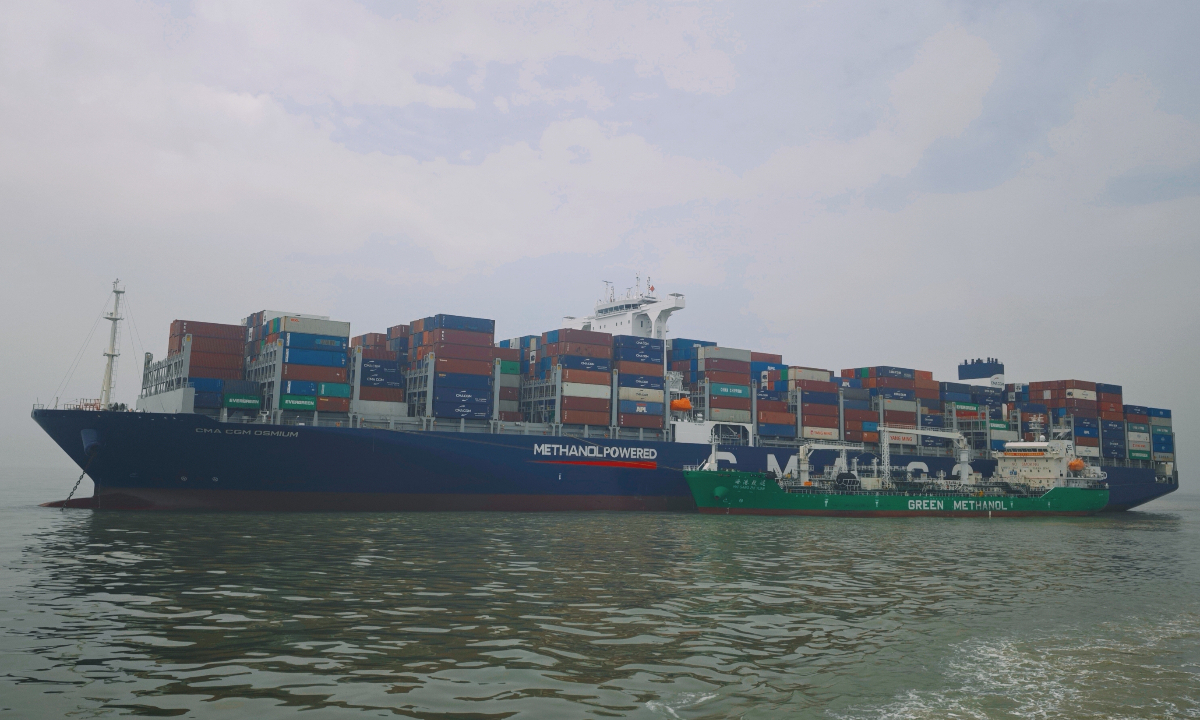
Shanghai Port has for the first time successfully completed simultaneously the bunkering of two types of green fuel for two international vessels at the offshore anchorage, marking a milestone in the port’s ability to provide diversified and large-scale marine fuel supplies, chinanews.com reported on Sunday.
Haigang Zhiyuan, a methanol bunkering vessel, successfully completed the bunkering of domestic-produced biomethanol to methanol-powered containership CMA CGM Osmium, which flies the Maltese flag, while Haigang Weilai, a liquefied natural gas (LNG) bunkering vessel, successfully completed the bunkering of LNG to Kota Elan, a Singapore-flagged dual-fuel LNG container ship at the Lühuashan Anchorage off Shanghai from Saturday to Sunday.
Most of the biomethanol supplied in the bunkering operation was produced by Shanghai Electric’s Taonan project. Which means the methanol feedstock was transported by land from Taonan, in Northeast China’s Jilin Province, to Dalian Port in Northeast China’s Liaoning Province, then shipped by sea to storage tanks in Shanghai, before being used for vessel bunkering at Shanghai Port. This established a cross-regional supply chain linking production in Jilin, transshipment in Dalian and bunkering in Shanghai, said the report.
The cross-provincial supply chain from Northeast China to Shanghai expands the market for domestic biomethanol and highlights progress in building a north-to-south green fuel transportation corridor, according to the report.
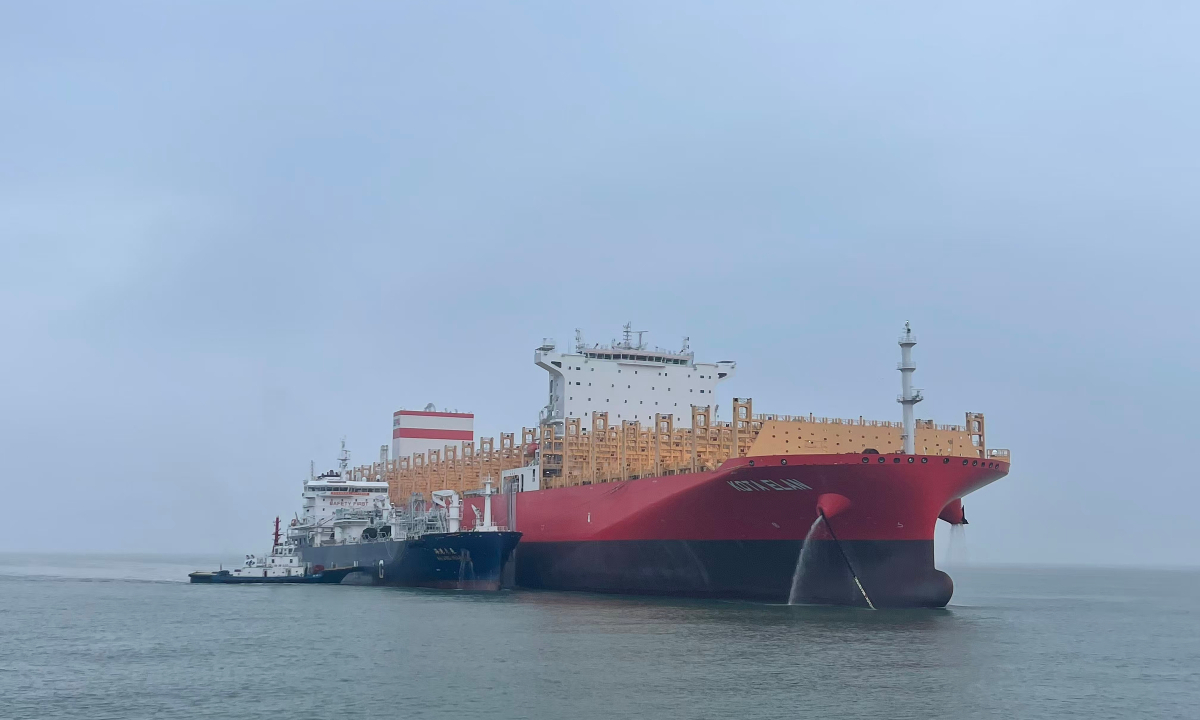
According to the Yangshan Border Inspection Station, the two vessels receiving the bunkering service have different sailing schedules. the CMA CGM Osmium is en route from Qingdao in Shandong Province to Ningbo in Zhejiang Province via Shanghai, while the newly built Kota Elan will conduct sea trials after bunkering.
Completing clean-fuel bunkering at an anchorage cuts berth, tugboat and pilotage costs, and reduces vessel waiting times, which lowers the energy replenishment costs for international vessels and strengthens Shanghai Port’s overall competitiveness as a shipping hub, chinanews.com reported.
Global Times
。
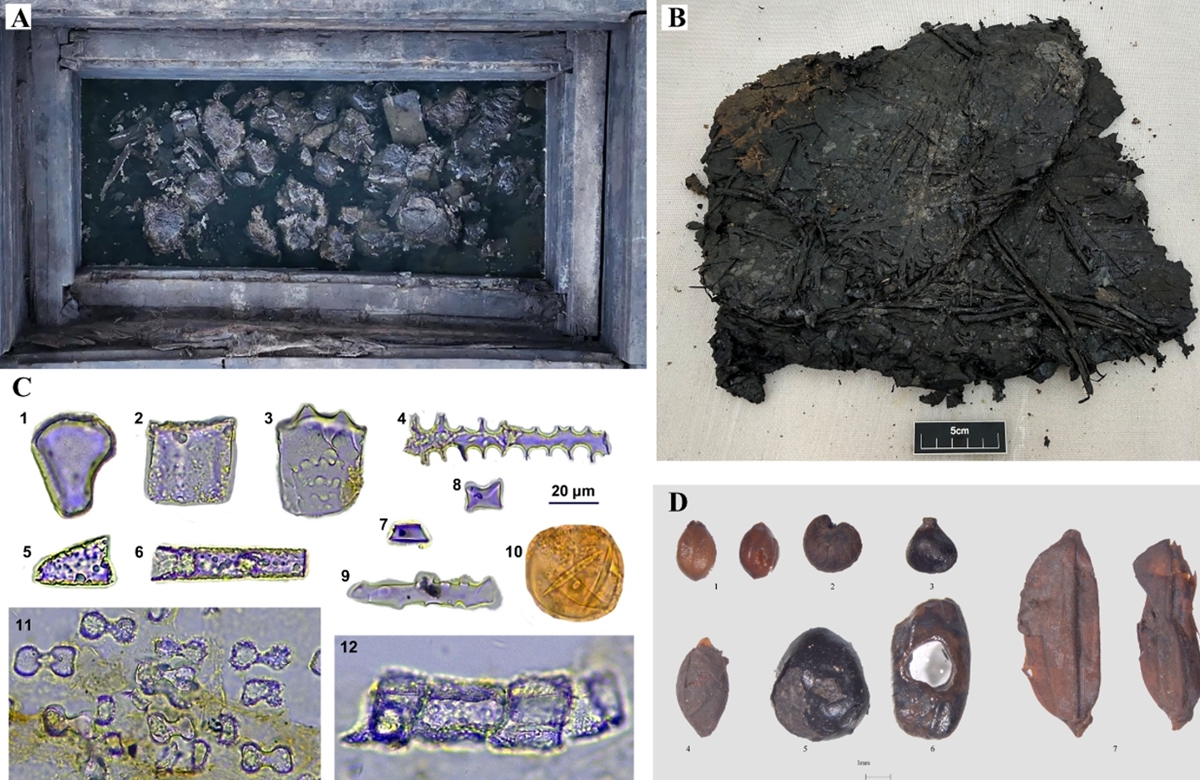
In March 2024, archaeologists from the National Center for Archaeology excavated a large number of well-preserved, waterlogged plant bundles from the tomb's outer coffin chamber. On-site, the plant bundles could be seen tightly wrapped in broad leaves and tied with plant-fiber cords.
A team of researchers led by the National Center for Archaeology, IVPP, and the Chinese Academy of Social Sciences examined 12 of the bundles and found that the wrapping leaves came from oak trees, while the cords were made from grasses.
The bundles mainly contained rice, broomcorn millet, foxtail millet, and cereal seeds, most of which were still in their husks and mixed with inflorescence material. Small amounts of peppercorn, mallow and rice-field weed seeds were also found.
The fact that the bundles were found in a tomb and mainly contained grains still in their husks suggests they were not everyday food, but offerings intended for funerary rituals. "This might reflect a Warring States-era belief that grains served as wealth for the dead in the underworld," Ge Yong, an associate researcher at the IVPP and the study's corresponding author, told the Global Times.
A Qin Dynasty (221BC-206BC) text describes a belief that "soybeans were gold and millet was money" for the dead, indicating that grains held symbolic significance in funerary culture. "The bundles therefore appear to have been ritual offerings prepared for the deceased," Ge said, "not food for the living."
The physical structure of the bundles also resembles that of zongzi, with grains wrapped in leaves and tightly secured with plant-fiber cords. "Similar practices of wrapping grains for burial have also been found elsewhere within the Chu cultural sphere," Ge said, "such as at the Chengyangcheng Site."
At the Chengyangcheng archaeological site in Henan Province, rice and broomcorn millet were also discovered wrapped in oak leaves. "An interesting fact is that we can still find zongzi wrapped with the same oak leaves now in regions related to the Chu cultural sphere."
"The findings suggest that wrapping grains as funerary offerings was a relatively common practice in the Chu state during the Warring States period," Ge said. "And this practice may have been an early form of the zongzi later associated with the legend of Qu Yuan."
These plant bundles share a structure similar to that of modern zongzi and to those described in legends and folklore. This might reflect how, through cultural exchange and heritage, these 2,200-year-old plant bundles likely evolved over centuries, shifting from sacrificial offerings to food, said Ge.
As diverse regional populations adapted the practice, it eventually transformed into the well-known Dragon Boat Festival tradition of eating zongzi. Thus, this structural resemblance might suggest a potential historical lineage; however, experts stressed that the Wuwangdun bundles should not simply be labelled as ancient zongzi.
"We can't define these plant bundles as the earliest zongzi, but rather, we can confirm that by 2,200 years ago at the latest, the Chu region had established a tradition of using this specific form of plant bundles for funeral rites. And this tradition could be a possible origin or precursor of the well-known zongzi," said Ge.
He added that the discovery provides critical physical evidence to explore the origins of zongzi and its cultural heritage.
。
Current article:http://8dzh.tichannangenzhuchuapin.cfd/news/20260826_61205.html
Published on:07:50:08
我的网站相关阅读
- 封锁2:4K图像质量建议AMD RADEON VII中的帧数没有上限
- 还有最后五公里,炮兵部队开始火力延伸,三个机步旅准备发起总攻,聚峰评论,原创 还有最后五公里,炮兵部队开始火力延伸,三个机步旅准备发起总攻
- 丰立智能:本次计提信用减值损失及资产减值损失合计减少公司2026年半年度利润总额约950万元
- iOS 16 正式版来了!这些功能你一定用得到!_iPhone_屏幕
- 网传广西南宁白沙大道一大楼倒塌?谣言!
- 真能跑起来!AI自主设计CPU:成功运行《毁灭战士》
- China takes 97% of H1 global humanoid robot shipments; supply chains, vast market drive rapid scale-up, intl reach: expert
- Four More Shots Please! Trailer: The Girl Gang Returns One Last Time to Bid Farewell in Style
- 炸锅!17岁张本美和连斩国乒3将登顶WTT,未来3年谁能拦住她?
我的网站最新文章
- 一个华人家庭在美国“卷足球”:一年3万美元,每天300公里
- 小米股东套利近22亿港元,股价下跌2.41%。
- Filing period for New Hampshire presidential primary opens
- 2025年淘宝京东618最后一波6月16日晚上8点开始买最便宜!京东618最新红包口令是:红包188
- 新华保险:上半年实现原保险保费收入1295.7亿元 同比增长6.9%
- 「恥を知れ!」高市首相「竹島の日」式典に“閣僚派遣見送り“で怒号の大荒れ…総裁選の“言行不一致”に橋下徹氏も「やるやる詐欺政治」と痛烈批判
- 13日0时至15时 北京新增本土新冠肺炎病毒感染者16例
- 福州港海铁联运再添新通道
- 中国财政部:将及时谋划出台务实管用的增量政策,中国财政部:将及时谋划出台务实管用的增量政策
- 实现“零”的突破!抚顺“大伙房水库鳙鱼”上榜全国名特优新农产品名录
- 热身赛-莱奥破门 雷比奇进球 AC米兰5-0客场大捷
- 原创 亏大了!累计倒闭上万家,订单暴跌50%,跟团游大坑真没人跳了!
- REPORTS: Janhvi Kapoor, Tiger Shroff and Lakshya to come together for a new project?
我的网站随机推荐
- 【フィギュア】女子金のアリサ・リュウ〝体脂肪率〟批判まで…中国から誹謗中傷の被害=海外報道
- 越来越多女性,确诊PMS
- 【仓单】8月26日上期所沪铅期货仓单较上一日下降25吨
- Dhurandhar: Karan Johar Says This Is His Favourite Performance of Ranveer Singh
- 南通大学杏林学院姜海之星实践团开展“巧手寻非遗,匠心悟文脉”主题实践活动
- 6月17日晚8点至6月18日当天一整天,618这28小时最便宜划算优惠力度最大
- 注意!杭州绕城高速部分路段出行有调整
- 纵横谈|让生态环境法典更好守护生活日常
- RAKsmart液冷技术如何实现PUE
- LinkedIn cuts more than 600 workers, about 3% of workforce
- 泰顺考察团走进滨江 跨越山海赴“文明之约”
- 116个科技小院助力乡村全面振兴
- 国际泳联公布巴黎奥运会游泳项目资格选拔体系