
沉默的羔羊(全文在线阅读)>
沉默的羔羊Exclusive: 'Super map’ rewrites moon’s geo-clock, ‘an important foundation for humanity to explore deep space,’ project scientists tell GT_我的网站
一 | 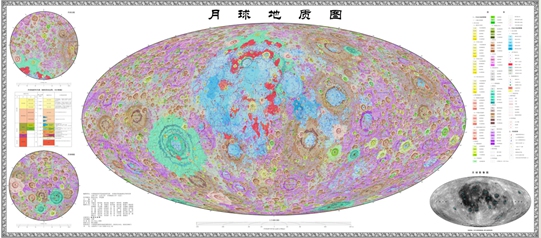 A massive new geological map of the moon, measuring about 2.8 meters long and 1.2 meters high, has recently made its debut in China, offering one of the most comprehensive portraits yet of the lunar surface and its billions of years of geological evolution. Compiled by the Institute of Geology under the Chinese Academy of Geological Sciences (CAGS), together with the Institute of Geochemistry under the Chinese Academy of Sciences, Jilin University, Shandong University and China University of Geosciences (Beijing), the 1:5,000,000-scale Geological Map of the moon marks 13,519 impact craters, 81 impact basins, 14 types of geological structures and 17 rock types, and includes detailed inset maps of the lunar north and south poles. More than simply a new rendering of the lunar surface, the map incorporates the latest findings from China's Chang'e lunar exploration program. Scientists involved in the project told the Global Times in exclusive interviews that the new map recalibrates key boundaries in the moon's geological chronology, updates the distribution of important lunar rock types and establishes a more systematic framework for interpreting the moon's evolution. "The Chang'e-5 and Chang'e-6 missions have successively returned samples from the moon's near and far side, producing findings that have significantly changed our understanding of lunar evolution," Ding Xiaozhong, a researcher at the Institute of Geology under CAGS and a core member of the mapping team, told the Global Times. Samples showed that volcanic activity on the moon continued until about 2 billion years ago - roughly one billion years later than previously thought under the conventional framework. Meanwhile, observations and samples from the lunar far side have provided new information about the composition and magmatic history of the moon's deep interior, Ding said. "These new discoveries created an urgent need for a new and systematic geological map that could integrate the latest data and research results and establish an updated framework for understanding lunar geology," he noted. The 1:5,000,000 scale was chosen with practical applications in mind. Compared with China's more detailed 1:2,500,000 lunar geological atlas released in 2024, the new map provides a more condensed, global view of the Moon, enabling researchers to quickly identify major geological relationships while also making it suitable for education, popular science and the early-stage planning of exploration missions. Jin Ming, an associate researcher at the Institute of Geology under CAGS, told the Global Times that the project also represents an important step toward establishing a mature Chinese standard for planetary geological mapping. Its newly designed symbols, legends and color system have been certified as a group standard by the Geological Society of China, filling a gap in China's standardized rules for planetary geological mapping. Although the latest project formally began in 2022 and took about four years to complete, Ding and Jin said its scientific foundations stretch back decades. Data accumulation and methodology development began with China's early lunar exploration missions, particularly after Chang'e-1 started returning scientific data. Several generations of Chinese planetary geologists have since developed a comprehensive system for lunar geological interpretation, remote-sensing data processing and map compilation. One of the toughest challenges was bringing together enormous quantities of remote-sensing data obtained by different instruments, Jin said. Different payloads aboard the Chang'e probes produced data with varying resolutions and spectral characteristics, requiring specially developed algorithms as well as extensive manual verification to place them under a unified mapping standard. "We had to make the different datasets compatible under the same system while striking a balance between scientific completeness and visual clarity - avoiding information overload without losing critical geological clues," Jin said. China previously released the world's first 1:2,500,000-scale high-precision lunar geological atlas in 2024. The newly completed 1:5,000,000 map is therefore not simply a reduced-scale copy, the scientists stressed, but a scientific update incorporating newly available data and revised interpretations of lunar chronology, lithology and geological evolution. China's new lunar geological map has achieved an all-round improvement over previous versions and is now at the international forefront, Ding said. We are the only country to have exclusive access to directly measured sampling data from the Chang'e-5 and Chang'e-6 missions. By using age anchors from lunar samples independently obtained by China to calibrate the geological chronology, this new data source and calibration system represents a core advantage of China." Like Earth, which is divided into geological periods such as the Cambrian and Jurassic, the Moon also has a geological timescale. One of the most significant tasks behind the new map was to recalibrate that "lunar clock." According to Jin, the recalibration draws on two major sources - the latest international isotopic dating results, including updated measurements of Apollo samples and lunar meteorites, and the precise age obtained from Chang'e-5 samples. The latter provided an especially important chronological anchor. Radiometric dating of Chang'e-5 basalt has placed its age at roughly 2 billion years, demonstrating that lunar volcanism persisted far later than had once been assumed and substantially changing scientists' picture of the moon's late-stage thermal evolution. Based on the updated evidence, the team refined the starting ages of several ancient lunar periods, including the Aitkenian, Nectarian and Imbrian periods, to approximately 4.33 billion, 4.17 billion and 3.92 billion years ago, respectively. More significantly, the researchers used the 2-billion-year age boundary to divide the Eratosthenian into an early and a late epoch. The team said this marks the first time an age boundary derived from samples independently collected by China has been incorporated into such a detailed Chinese lunar geological chronology. "The moon's story itself has not changed, but its timeline has," Jin said. "We once thought that major lunar volcanism had essentially cooled down about 3 billion years ago. Now we know that the Moon remained volcanically active until at least about 2 billion years ago. That means the thermal evolution of the lunar interior and many of the causal relationships in its later history need to be re-examined." Ding highlighted a newly mapped rock type in the South Pole-Aitken Basin - gabbronorite - identified with the help of the latest Chang'e-4 and Chang'e-6 exploration results. The vast basin on the lunar far side is one of the moon's largest and oldest impact crater. "This is like being able to directly see material from deeper inside the moon," Ding said. "Previously, much of this could only be inferred from remote-sensing observations. With Chang'e-4 in-situ exploration and Chang'e-6's returned samples, we now have much stronger evidence for identifying its existence and distribution." Another important revision concerns KREEP, a lunar geochemical component enriched in potassium, rare-earth elements and phosphorus and commonly associated with elevated concentrations of radioactive heat-producing elements such as thorium and uranium. According to Ding, earlier models suggested that KREEP-rich material was concentrated in a relatively limited area. Higher-resolution data used in the new mapping project indicate a broader and more continuous distribution than previously thought, suggesting that its abundance may have been underestimated. Ding said the finding is scientifically important not only for assessing potentially resource-rich lunar materials, but also because the distribution of KREEP provides clues to the crystallization of the early lunar magma ocean, the thickness of the lunar crust and the moon's internal thermal evolution. The map's colors also carry geological meaning. The team follows a principle of "lighter for younger, darker for older": relatively young Copernican impact materials are depicted in bright pale yellow, ancient Aitkenian impact materials in deep purplish red, while mare basalts are represented in varying shades of blue. "The color system combines the logic of geological evolution with elements of traditional Chinese color aesthetics, giving China's lunar geological maps a distinctive scientific and visual identity," Ding said. Beyond basic science, the researchers said the new geological map can serve as a strategic base map for China's future lunar exploration, including subsequent Chang'e missions and planning related to the International Lunar Research Station (ILRS). A refined geological chronology can help scientists understand the age and modification history of candidate regions; updated rock mapping can identify areas of particular scientific or resource interest; and the global-scale representation allows mission planners to compare broad regions before moving to higher-resolution site studies. Asked whether the map could directly support the Chang'e-7 and Chang'e-8 missions, Jin stressed that its role is primarily strategic rather than tactical. "The 1:5,000,000 geological map is a global-scale foundational map. It can be used for broad comparisons of potential landing regions and for evaluating their overall geological context," Jin said. "Precise landing-site selection and detailed rover-route planning, however, require higher-resolution regional geological maps. The two work together, moving progressively from the global scale to finer regional scales." The scientists also stressed that the map is intended to be shared with the international scientific community. Digital versions are expected to be released through professional publications and public scientific databases, while the standardized symbols and mapping rules could facilitate exchanges with other planetary geological mapping systems. Ding said significant room remains for international cooperation, from comparing and translating different geological mapping standards to joint studies of the evolution of the lunar far side and the origin of the ancient South Pole-Aitken Basin. "China possesses unique exploration data and returned lunar samples, which provide a strong foundation for cooperation," Ding said, adding that planetary science, scientific training and deep-space exploration technologies all offer potential areas for expanded exchanges. "A precise geological map of the moon is an important foundation for humanity to explore deep space and understand the universe," Jin said. The latest map, he noted, is not an endpoint. As China proceeds with subsequent lunar exploration missions and acquires new observations and samples, the geological picture of the Moon will continue to be refined. "Future exploration will allow us to keep updating our understanding of lunar geology," Jin said. "At the same time, we hope these results can contribute to broader international scientific cooperation and to humanity's exploration of the moon." 。 讯 中国物流与采购联合会8月11日发布数据显示,2026年7月份中国电商物流指数为111.2点,环比回落0.2点。各分项指数中,库存周转率指数、物流时效指数、履约率指数、满意率指数有所回升,总业务量指数、农村业务量指数、人员指数、实载率指数、成本指数小幅回落。 电商物流总业务量指数小幅回落。7月份,电商物流总业务量指数为128.4点,环比回落0.2点。分地区来看,西部、东北部地区分别回升0.9、0.6点,中部地区小幅回落0.4点,东部地区与上月持平。 电商物流农村业务量指数有所回落。
二 | 7月份,电商物流农村业务量指数为126.5点,环比回落0.8点。地区电商物流农村业务量走势分化,西部、东北部指数水平持续向好,分别回升0.2、0.6点;东部、中部地区有所下降,其中中部地区受极端天气影响,回落幅度最大,环比回落1.4点。 电商物流供给端稳定向好。7月份,企业库存流转效率进一步提升,库存周转率环比回升0.4点,实现连续三个月回升;物流服务质量稳步优化,自2月份起,物流时效、履约率、满意率连续回升,7月份分别回升0.1、0.3和0.1点。成本指数环比回落0.3点,企业经营压力有所舒缓。
三 | 7月,电商物流迎来季节性调整。电商促销活动相继结束,平台集中促销效应逐步消退,市场回归常态化运行,电商物流需求有所回落,但行业运行基本盘依旧稳固,总业务量指数仍高于全年平均水平,电商物流总业务量与农村业务量均保持20%以上的同比增速。 从需求结构看,衣装服饰、美妆护肤等刚需类商品消费基本盘保持稳固;以旧换新政策持续发挥带动作用,“夏日经济”“考后经济”成为家电消费与数码消费的重要驱动力,空调、除湿机、手持电扇等清凉家电进入销售旺季,手机、电脑、平板电脑等“升学套装”销售情况良好。 从供给端看,面对极端高温、强降雨等天气的复杂环境,物流企业持续优化作业组织模式,合理调整干线运输调度计划,加大对一线分拣、末端派送从业人员的劳动防护与后勤保障,多措并举对冲外部不利因素影响,保障电商物流链条平稳运行。8月份,伴随暑期消费持续释放,叠加促消费政策效能进一步显现,电商物流有望止跌回稳,延续平稳运行态势。版权申明:凡注有“”或电头为“”的稿件,均为独家版权所有,未经许可不得转载或镜像;授权转载必须注明来源为“”,并保留“”的电头。 。 Current article:http://8dzh.tichannangenzhuchuapin.cfd/list_c0us/pqs.html Published on:15:40:29 |


